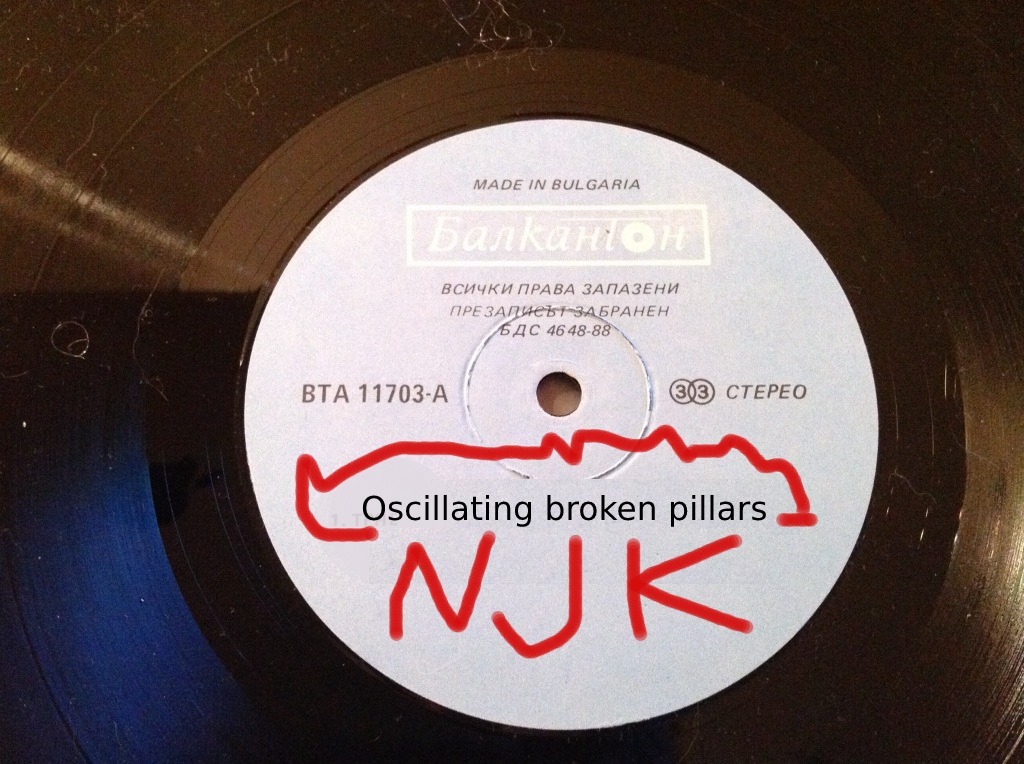
OSCILLATING BROKEN PILLARS
Speculative realist play in two acts
ANABASIS. ONLINE RESIDENCY, 2021
In collaboration with Nikolay Karabinovych
Curated by Oleksandr Sushynskii
Text of the play:
A critique of the modern repressive machine of adapting refugees into present capitalist discourse. Written in the footsteps of Paul Celan’s poetics.
The play itself explores the interaction of a refugee with the migration policy of modern European states to adapt and assimilate the subject into the state machine. In the world of the future, the refugee ceases to be an anomaly, but becomes a new political subject, which may soon take the political platform, become a new voice in the modern city, and even stir up unrest and new social processes.
Curator Oleksandr Sushynskii about poem:
Firstly I’m going to speak about the Neue Judische Kunst group. Harri Kraievets and Nikolai Karabinovich (members of NJK) created some kind of a radio play named “Oscillating broken pillars” in which four wind instruments got into a broken magic items shop where the owner’s grandson wants to socialise them. During all the play the instruments are crying: “But we don’t want that! We don’t believe in that! We’re other, we’re different! We don’t want to be like you!” A psychoanalyst comes to the store and deliberately shouts out fragmentary expressions from its professional vocabulary: “Geste à peau! dénégation! aliénation! jouissance!” Ultimately, everything ends in a way of “pogrom”. Someone says: “We left our unbearable homeland that has broken us, but we don’t need any repair!” The message of this work was for me: leave us alone, we do not need to be cured and instilled by your values. Today we inevitably face an unsolvable dilemma. Either we are assimilated by force and become a part of a global system, including erased identity (e.g. the regime of social networks “transparency”, conditions of precarity and instability) or we reject it in favour of a vulnerable separateness and “uniqueness”. The only problem is that isolationism seems to be a false alternative because, as Claude LéviStrauss and other anthropologists have shown, at the structural level within even the most closed tribes of Amazonia or Australia, the same patterns are observed – hierarchy, regimentation and repression. I would say identity is as dead as God is. You expressed this more gracefully at the very beginning, when you were talking about Celan and his overcoming the identity construct. While omitting the neoliberal regime of capitalism we put ourselves right into the “Midsommar” (2019)
Moreover, the apology of Nature by Jean-Jacques Rousseau was debunked and carefully deconstructed by Jacques Derrida, who showed how naive and even dangerous it is to think about the human out of the culture, language and structures. This inextricable dilemma and hopelessness is the key mood of the artwork by Neue Judische Kunst in my opinion.
ANABASIS. ONLINE RESIDENCY: inspired by Paul Celan, one of the most important German-speaking poets of the twentieth century, featured German and Ukrainian artists working with new media. The artists were invited to deal with questions of identity and posthumanism in a funded workshop and a project phase. The resulting works are presented in November 2021.